What Makes a Legit FiveM Script Store? A Buyer’s Checklist
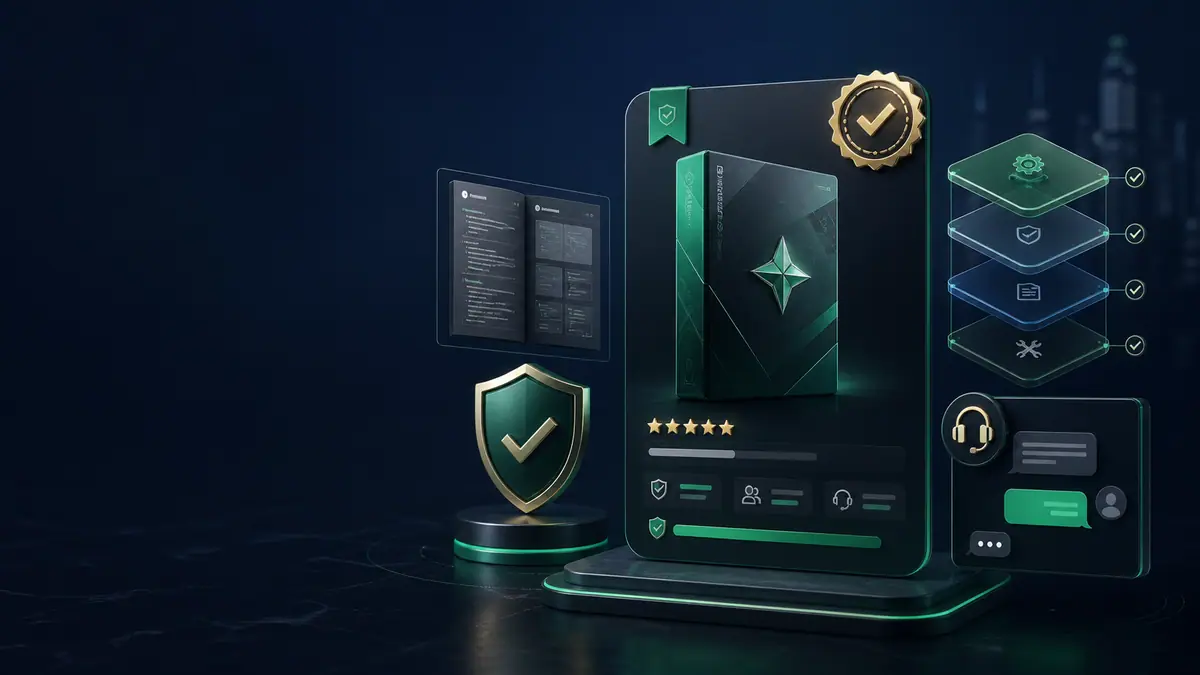
Buying a FiveM resource is not only a feature decision. You are choosing code that will run on your server, interact with player data, affect your performance budget, and need maintenance when the rest of your stack changes.
A legitimate script store should make that decision easier. It should tell you what the resource does, what it depends on, what you are licensed to use, and how support works after purchase.
1. Look for a real product definition
A useful product page explains the problem the resource solves before listing every button in the UI. It should distinguish between:
- included features;
- optional integrations;
- framework support;
- configurable values;
- features planned for a future release;
- features available only in a different product or edition.
Be careful with vague promises like “works with everything” or “zero performance impact.” A serious developer names the tested integrations and explains the boundaries.
2. Check the resource structure and dependencies
FiveM resources are described by an fxmanifest.lua file, which identifies scripts, files, dependencies and other metadata. The official Cfx.re documentation explains how the manifest and dependency entries work. Read the resource manifest reference.
Before installing, record:
- resource folder name;
- required and optional dependencies;
- supported game/framework versions;
- database requirements;
- inventory, fuel and voice integrations;
- whether the UI is included in the resource packfile;
- whether source files are editable or escrowed.
If the seller cannot answer these questions, the price is not the only risk you are taking.
3. Licensing should be readable
The license should state whether you can use the resource on one server or multiple servers, whether you can modify it, whether redistribution is prohibited, and how a transfer or ownership change is handled. If the product uses third-party code or assets, the seller should respect those licenses too.
Never treat leaked code as a bargain. It may contain backdoors, stolen assets, hidden dependencies or no update path. A cheap resource that compromises a server is an expensive incident.
4. Documentation is part of the product
Good documentation should get you from download to a tested feature. It should include installation order, configuration examples, framework notes, exports/events, permissions, database steps and troubleshooting.
For UI resources, documentation should also explain NUI callbacks and failure behaviour. Cfx.re notes that NUI callbacks must return a response on every path or the browser request can time out. Read the NUI callback documentation.
Documentation is not decoration. It is how you maintain the resource when the original author is offline.
5. Evaluate security claims carefully
The client can be modified by the player. Therefore, a client event or NUI payload is a request, not proof. Server-side code should validate money, inventory, permission, position, ownership and rate limits for any action that changes the game state.
Cfx.re's security guide explicitly recommends server-side checks instead of trusting values supplied by the client. Read Secure Your Events.
Ask whether the product has:
- server-side permission checks;
- validation for sensitive arguments;
- cooldowns for repeatable events;
- safe handling of missing players/entities;
- clear admin command permissions;
- a process for reporting vulnerabilities.
6. Look for maintenance signals
An active project does not need to release every week. It should, however, communicate changes. Useful signals include a changelog, version numbers, compatibility notes, issue tracking, release dates and a support channel where technical questions receive technical answers.
Ask what happens when ESX, Qbox, QBCore, ox_lib, inventory or FiveM changes. A good answer describes the support policy, not just “we will fix it.”
7. Compare the buying experience with the engineering experience
Marketing and engineering should agree. If a product page says “customisable,” the docs should show where the configuration lives. If it says “framework compatible,” the setup guide should show the supported data paths. If it says “lightweight,” the developer should explain what updates are event-driven or interval-based.
Zloma Scripts aims to keep product claims tied to documented resource behaviour: compatibility, UI controls, configuration boundaries and support paths are more useful than inflated superlatives. You can review the Zloma Scripts catalogue and the linked documentation before deciding whether a resource fits your server.
A short pre-purchase checklist
Before paying, answer yes to these questions:
- Do I know exactly what the product includes?
- Do I know which framework and dependencies it supports?
- Is the license clear?
- Is there installation and troubleshooting documentation?
- Are sensitive actions validated server-side?
- Is there a changelog or release history?
- Can I contact support through a real, documented channel?
- Does the product solve a problem my server actually has?
If several answers are no, wait. A polished preview cannot replace technical clarity.
Final takeaway
A legitimate FiveM script store sells more than a download. It provides clear scope, lawful distribution, honest compatibility, usable documentation and an accountable update path. Those are the features that protect your server after the screenshot stops looking new.
Keep learning
FiveM Client vs. Server Events: How to Secure UI Actions
Understand why FiveM clients cannot be trusted, how to validate network events, and how to secure NUI actions involving permissions, inventory, money and vehicles.
Framework IntegrationESX, QBCore, Qbox or Standalone: Choosing a FiveM HUD Setup
Compare ESX, QBCore, Qbox and standalone HUD integrations, understand dependency boundaries, and install a FiveM HUD without guessing at framework data.
Server ArchitecturePremade vs. Clean FiveM Server Base: Which Is Better?
Compare a premade FiveM server package with a clean base. Learn how to evaluate dependencies, licensing, performance, security and long-term maintenance before you buy.
Build a better server experience
Need a production-ready FiveM resource?
Explore Zloma Scripts for practical resources with clean interfaces, framework compatibility, and documentation you can actually use.
Browse Zloma Scripts